Published: 26 Aug 2026 · Last verified: 5 Sep 2026 · Next review: Dec 2026 Cost figures are re-checked against permit records quarterly. Changes are logged in Corrections.
Most ADU cost articles give you a range and stop. “$150,000 to $400,000.” That range is technically correct and practically useless — it is wide enough to include both a garage conversion and a coastal custom build.
So we did something different. We modeled one specific unit: 800 square feet, detached, new construction, single story, Los Angeles County, mid-grade finishes. Then we priced every phase so you can see what each number actually buys.
The total came to $320,000, or $400 per square foot.
Compare any two builds on the same six-phase ledger → Compare.
The short answer
| 800 sq ft detached ADU · Los Angeles County · 2026 | Amount |
|---|---|
| Total build cost | $320,000 |
| Cost per square foot | $400 |
| Largest single line | Systems + interior, $147,000 |
| Share of budget in one kitchen and one bathroom | 46% |
That last row is the one worth sitting with. Nearly half of an ADU budget goes into two rooms, and that share does not shrink when the building does. We will come back to it.
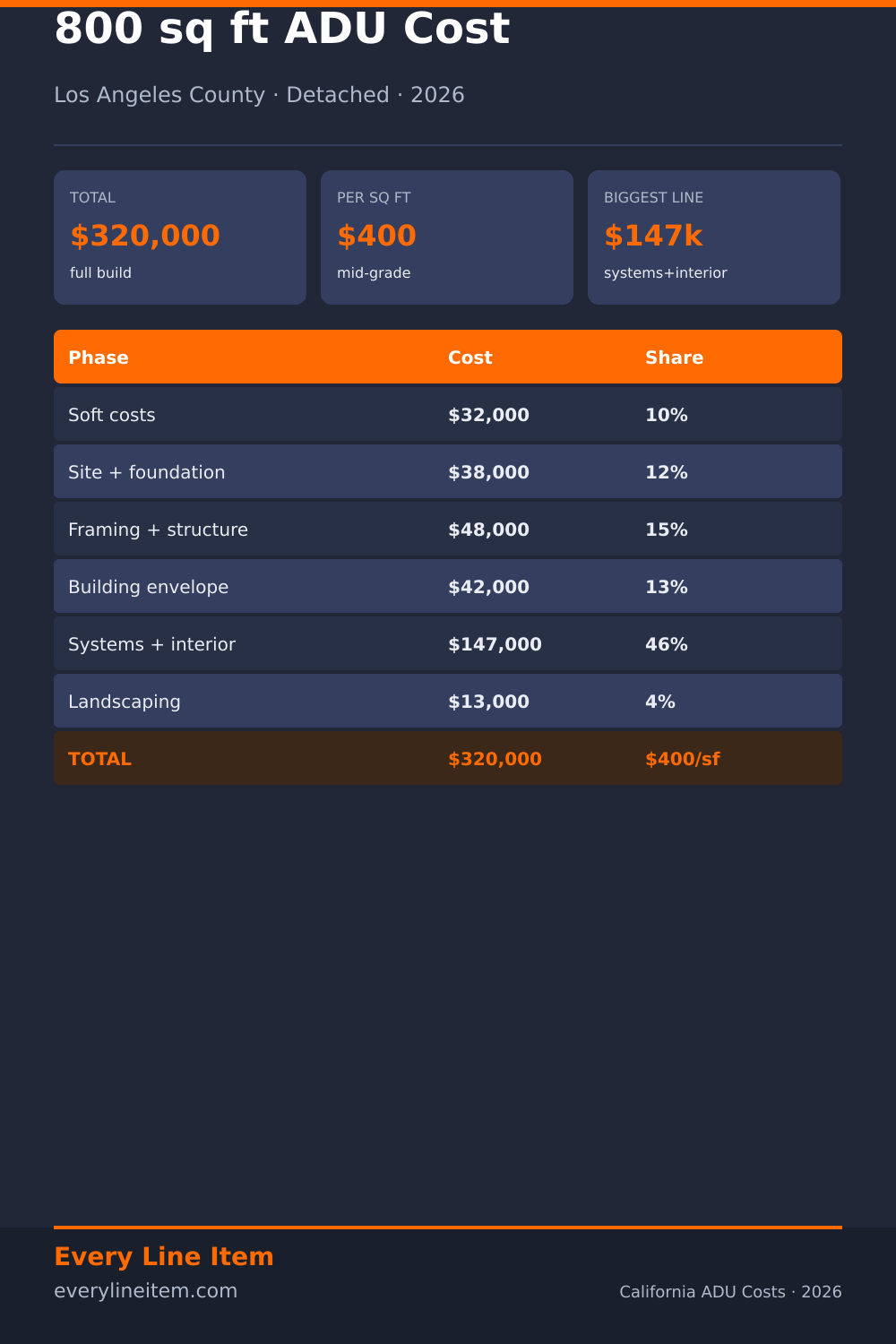
Pin this breakdown: right-click / long-press the image, or use the Pinterest share button.
The full line-item breakdown
Six phases. Every project in this series uses the same six, so you can hold any two builds side by side and the rows still line up.
| Phase | Cost | Share |
|---|---|---|
| Soft costs (design, permits, plan check) | $32,000 | 10% |
| Site work + foundation | $38,000 | 12% |
| Framing + structure | $48,000 | 15% |
| Building envelope | $42,000 | 13% |
| Systems + interior | $147,000 | 46% |
| Landscaping & hardscape | $13,000 | 4% |
| Total | $320,000 | $400 / sq ft |
Notice what is not the biggest number. The foundation everybody worries about is 12%. Framing is 15%. The roof and siding together are 13%.
The money is inside the walls, after the shell is up.
Where 46% of the budget goes
Systems and interior covers one kitchen, one bathroom, the electrical panel and rough-in, plumbing supply and waste, the heat pump and ducting, insulation, drywall, flooring, paint, and every fixture and appliance in the unit.
Here is the part that surprises homeowners: almost none of that scales with square footage.
A kitchen has a sink, a range, a refrigerator, cabinets and a run of counter whether the unit is 400 square feet or 1,200. A bathroom has one toilet, one shower pan, one vanity and one exhaust fan. A heat pump sized for a small unit costs nearly what one sized for a larger unit costs, because the smallest units manufacturers make are already bigger than a small ADU needs.
What does scale is framing lumber, drywall sheets, flooring, roofing and siding. Those are the cheap parts.
This is the whole reason the next table exists.
Why “just build a smaller one” doesn’t work
Cutting the plan in half does not cut the cost in half. The same unit at 400 sq ft prices out at $215,000 — two-thirds the cost for half the space, and $537 per square foot instead of $400.
Permits, foundation, the sewer connection, the electrical service run, the kitchen and the bathroom are close to fixed. Only lumber, drywall, flooring and roofing scale down, and those are the four cheapest rows.
→ Full six-phase comparison: 400 sq ft ADU cost in California
What moves the number most
Five variables account for nearly all of the spread between one quote and another.
1. Region. Site-built detached ADUs in Southern California generally run $375 to $600 per square foot, with the coastal band at the top of that. Inland Riverside and San Bernardino County builds come in materially lower for the same drawings. Region is the single largest driver, and it is the one you cannot change. → Coastal vs inland: same plan, different bill
2. Site slope. A flat, accessible backyard is the baseline. A sloped lot adds retaining, engineered footings and often a crane or pump for concrete. This alone can add $20,000 to $50,000 without changing a single thing about the building.
3. Utility distance. How far the ADU sits from the main sewer line and the electrical panel decides the trenching bill. Sixty-five feet of trenching, a panel upgrade and conduit runs comes to roughly $18,000 in Los Angeles County — and that number barely moves whether the ADU is 400 or 800 square feet.
4. Factory-built vs site-built. Modular and panelized units have come in 10% to 25% below comparable site-built projects. The savings are real, but they are partly offset by crane and transport costs, and the delivery constraints are decided by your street width and overhead lines. → Modular vs site-built ADU cost
5. Finish grade. The difference between builder-grade and mid-grade finishes across a full unit is typically $15,000 to $30,000. This is the only variable on the list you fully control after permits are pulled.
What this number does not include
This is the section most cost articles leave out, and leaving it out is how a $320,000 build becomes a $380,000 surprise.
| Not included in $320,000 | Typical impact |
|---|---|
| Construction loan interest | Carried for 9 to 14 months |
| Property tax reassessment | The ADU’s value is added to your assessment |
| Vacancy before first tenant | 1 to 3 months is common |
| Ongoing property management | 8% to 10% of rent, if you don’t self-manage |
| Contingency | 10% to 15% — budget it, don’t hope |
On this build, a 12% contingency is $38,400. Treat it as a line item, not as optimism.
→ Full year-one ownership cost, including financing and carrying costs: ADU all-in cost in California
One clarification on the tax line, because it is widely misunderstood: building an ADU does not trigger reassessment of your existing home. Only the new construction is added to the assessed value. Your original Proposition 13 base year value on the main house is untouched.
Put your own quote in these six rows
We made a blank version of the six-phase ledger. Drop your contractor’s numbers into it and see which line doesn’t match ours.
Download the worksheet — CSV (import to Google Sheets), no email required
Want the regional benchmark ranges for each phase, updated quarterly?
Methodology and sources
Every figure on this page is a modeled median, not a quote. Here is exactly how it was built, so you can check it or reproduce it yourself.
| Input | Source |
|---|---|
| Statewide ADU rules, size limits, and fee exemptions | California HCD ADU Handbook |
| 2026 changes to State ADU Law | HCD Addendum, December 2025 |
| Declared construction valuations, unincorporated LA County | EPIC-LA permit portal |
| Declared construction valuations, City of Los Angeles | LADBS Permit & Inspection Report |
| Permit record dataset | LA County Open Data — EPIC-LA Permit Finder |
| Phase-level cost shares for residential construction | NAHB Cost of Construction Survey |
| Per-square-foot construction price benchmarks | NAHB Survey of Construction |
| Regulatory share of finished build cost | NAHB regulatory cost study, June 2026 |
| Zoning and parcel constraints | ZIMAS |
Check this number against your own address
Most California jurisdictions publish permit records online, including the declared construction valuation for each project. That declared valuation is the closest thing to a real local baseline you can get without paying anyone.
- Open EPIC-LA for unincorporated LA County, or the LADBS Permit & Inspection Report for addresses inside the City of Los Angeles.
- Search recent ADU permits within about a mile of your address.
- Compare the declared valuation to the phase totals on this page.
Declared valuations run below contract price — treat them as a floor, not a total. Full detail on Methodology.
If your local numbers diverge meaningfully from ours, we want to know. See Corrections.
Our position
We don’t build ADUs. We don’t sell plans. We don’t sell your information to contractors. No figure on this site has been paid for or reviewed by anyone whose costs we publish. More on About.
Figures are Los Angeles County, 2026, stated as medians of contractor ranges. Costs vary by jurisdiction, site access, and finish level. This is construction cost information — not a quote, and not legal, engineering, or financial advice. Confirm requirements with your local building department and a licensed California contractor.
Frequently asked questions
How much does an 800 sq ft ADU cost in California?
Roughly $320,000 in Los Angeles County in 2026, or about $400 per square foot for a detached, single-story, new-construction unit with mid-grade finishes. Southern California site-built ADUs generally fall between $375 and $600 per square foot depending on region, site slope, and utility distance.
Is an 800 sq ft ADU worth it?
On a cost-per-square-foot basis, an 800 sq ft unit is meaningfully more efficient than a 400 sq ft one — $400 versus $537 per square foot — because permits, foundation, utility connections, the kitchen, and the bathroom are close to fixed regardless of size. If your lot and local rules allow 800 square feet, the larger unit usually delivers more space per dollar.
Why is a smaller ADU more expensive per square foot?
Because the expensive parts do not shrink. One kitchen, one bathroom, one heat pump, one sewer connection, and one set of permits cost nearly the same at any size. Only framing, drywall, flooring, and roofing scale down with area, and those are the least expensive phases of the build.
How long does an ADU take to build?
Typically nine to fourteen months from first drawing to final inspection in Los Angeles County. Permitting is the least predictable segment; actual construction on a detached 800 sq ft unit generally runs five to seven months.
Can I build an ADU without a permit?
No. An unpermitted ADU cannot be legally rented, will not appear in your property records, and creates disclosure problems at sale. California has a legalization pathway for some existing unpermitted units, but it requires bringing the structure up to code — which routinely costs more than permitting a new build correctly from the start.
Do ADUs increase property tax?
Yes, but only on the new construction. The assessed value of the ADU is added to your existing assessment. Building an ADU does not trigger a reassessment of your main house, and your original base year value on the existing home is preserved.