Published: 2 Sep 2026 · Last verified: 5 Sep 2026 · Next review: Dec 2026 Cost figures are re-checked against permit records quarterly. Changes are logged in Corrections.
Most homeowners hear “build smaller” and hear “spend less.” On a California ADU, those are not the same sentence.
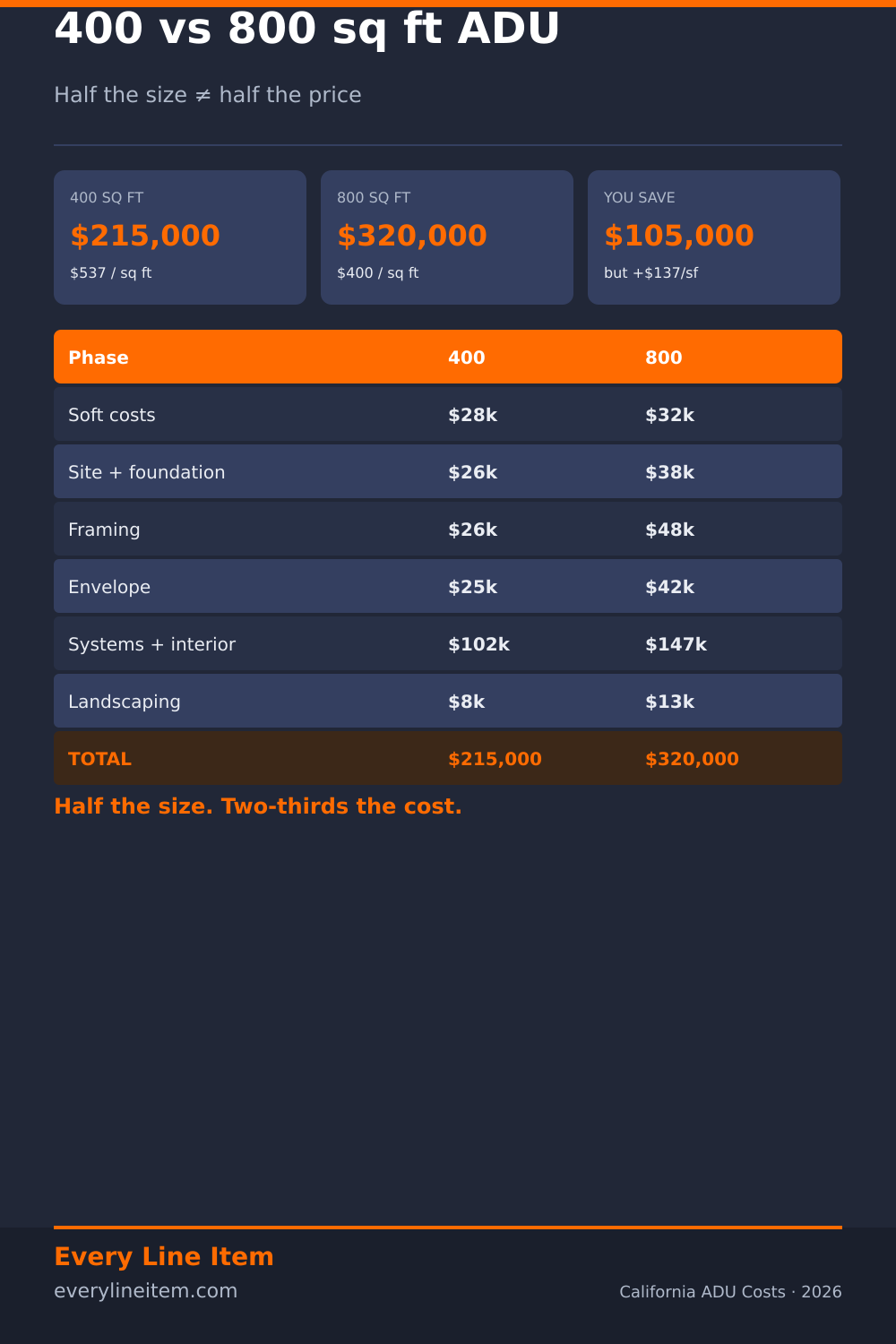
We modeled a 400 square foot detached ADU — new construction, single story, Los Angeles County, mid-grade finishes — using the same six phases as our 800 sq ft ADU cost breakdown. The total came to $215,000, or $537 per square foot.
That is two-thirds the cost of the 800 sq ft unit ($320,000) for half the floor area. You save $105,000 in absolute dollars and pay $137 more per square foot.
The short answer
| 400 sq ft detached ADU · Los Angeles County · 2026 | Amount |
|---|---|
| Total build cost | $215,000 |
| Cost per square foot | $537 |
| Same unit at 800 sq ft | $320,000 / $400 per sq ft |
| Absolute savings vs 800 | $105,000 |
| Per-sq-ft premium vs 800 | +$137 (34% higher) |
The kitchen and bathroom still dominate. On a 400 sq ft plan they occupy a larger share of the floor, so there is less inexpensive living space to pull the average down.
The full line-item breakdown
Same six phases as every post in this series. Hold this table next to the 800 sq ft table and the rows still line up.
| Phase | Cost | Share |
|---|---|---|
| Soft costs (design, permits, plan check) | $28,000 | 13% |
| Site work + foundation | $26,000 | 12% |
| Framing + structure | $26,000 | 12% |
| Building envelope | $25,000 | 12% |
| Systems + interior | $102,000 | 47% |
| Landscaping & hardscape | $8,000 | 4% |
| Total | $215,000 | $537 / sq ft |
Compare that to the 800 sq ft model: soft costs only drop $4,000. Foundation drops $12,000. Framing drops $22,000. Envelope drops $17,000. Systems drop $45,000 — still leaving a six-figure interior. Landscaping drops $5,000.
The phases that shrink are the cheaper ones. The phases that barely move are the expensive ones.
Why fixed costs eat a small ADU
A 400 sq ft unit still needs:
- One kitchen (sink, range, refrigerator, cabinets, counter run)
- One bathroom (toilet, shower, vanity, exhaust)
- One heat pump sized for a small dwelling
- One sewer lateral connection and one electrical service run
- One set of architectural drawings, structural calcs, Title 24 energy docs, and building permits
Almost none of that scales with floor area. A kitchen for 400 sq ft is not half the kitchen for 800. A bathroom is a bathroom. The smallest heat pumps on the market are already oversized for many studio ADUs, so the equipment line barely moves.
What does scale: framing lumber, sheathing, drywall sheets, flooring square footage, roofing squares, and siding. Those are real savings — and they are also the four cheapest rows in the build.
| Cost behavior | Examples on a 400 sq ft ADU |
|---|---|
| Near-fixed | Permits, design, sewer tap, electrical run, kitchen, bath, HVAC equipment |
| Partially scales | Foundation excavation and concrete, windows, insulation |
| Scales with area | Framing lumber, drywall, flooring, roofing, siding |
That split is why half the size is not half the price. It is also why the per-square-foot number rises as the unit shrinks.
Pin this breakdown: right-click / long-press the image, or use the Pinterest share button.
400 vs 800 side by side
These numbers match the comparison table in the 800 sq ft post. They are the same model, not a second estimate.
| Phase | 400 sq ft | 800 sq ft |
|---|---|---|
| Soft costs | $28,000 | $32,000 |
| Site work + foundation | $26,000 | $38,000 |
| Framing + structure | $26,000 | $48,000 |
| Building envelope | $25,000 | $42,000 |
| Systems + interior | $102,000 | $147,000 |
| Landscaping & hardscape | $8,000 | $13,000 |
| Total | $215,000 | $320,000 |
| Per sq ft | $537 | $400 |
Half the size. Two-thirds the cost.
You gave up 400 square feet of living space and saved $105,000. On a dollars-per-foot basis the small unit is 34% more expensive to build. And the market agrees. In San Diego, a 500 sq ft one-bedroom ADU commonly runs around $300,000, which is roughly $600 per square foot, while a 1,000 sq ft unit lands near $425,000, or about $425 per square foot. The curve bends the same way everywhere in Southern California.
Regional project data across Southern California shows the same curve: smaller studios often land near $500–$600 per square foot, while 800–1,000 sq ft units commonly land closer to $375–$450 when site conditions are comparable.
When 400 still makes sense
The larger unit is usually the better dollar if your lot and local rules allow it. That does not mean 400 is never the right call. It often is, for reasons that have nothing to do with cost-per-foot math.
Lot and setbacks. Many parcels cannot fit an 800 sq ft footprint after rear and side setbacks, existing trees, and required open space. A 400 sq ft studio can clear zoning where a larger plan cannot.
Local size caps. Some jurisdictions still effectively constrain ADU size through lot coverage, floor-area ratios, or height limits even where state law sets a high ceiling. Always check the current local ordinance and the California HCD ADU Handbook — rules moved fast between 2020 and 2026.
Budget ceiling. $215,000 plus contingency is still a large number, but it is $105,000 less cash or loan proceeds than the 800 model. If financing capacity, not efficiency, is the binding constraint, smaller wins.
Use case. A studio for a caregiver, adult child, or short-term rental target may not need a second bedroom. Paying for unused floor area is not efficiency; it is overbuilding.
Construction disruption. A smaller footprint can mean less trenching, fewer neighbors impacted, and a shorter framing schedule — soft benefits that do not show up in the phase table.
If you are choosing between sizes, run both through the same six phases. Do not pick 400 because it “sounds cheaper” without looking at the per-foot and the absolute totals together.
What still moves the number
The same five variables that drive the 800 model apply here — region, site slope, utility distance, factory-built vs site-built, and finish grade. On a small unit, utility distance and finish grade punch even harder on a percentage basis, because the variable shell is smaller.
| Variable | Typical impact on a 400 sq ft ADU |
|---|---|
| Coastal vs inland Southern California | Can swing $75–$150 / sq ft |
| Sloped lot / retaining | +$15,000 to $40,000 |
| Long utility runs / panel upgrade | Often $12,000–$20,000, barely size-dependent |
| Modular / panelized | 10%–25% below comparable site-built, before crane/transport |
| Builder-grade vs mid-grade finishes | $12,000–$25,000 across the unit |
For a deeper look at the permit and design line alone, see ADU soft costs in California. Soft costs on this model are $28,000 — lower than the 800 model by only $4,000.
What this number does not include
| Not included in $215,000 | Typical impact |
|---|---|
| Construction loan interest | Carried for 9 to 14 months |
| Property tax on new construction only | ADU value added to assessment |
| Vacancy before first tenant | 1 to 3 months is common |
| Property management | 8% to 10% of rent if not self-managed |
| Contingency | 10% to 15% — budget it |
A 12% contingency on this build is about $25,800. Treat it as a line item. Building an ADU does not reassess your existing home under Proposition 13; only the new construction is added.
Garage conversions are a different animal — often lower absolute cost, different phase mix, and their own failure modes around parking replacement and fire/egress. See the garage conversion ADU cost breakdown for that path.
Put your own quote in these six rows
We made a blank version of the six-phase ledger. Drop your contractor’s numbers into it and see which line doesn’t match ours.
Download the worksheet — CSV (import to Google Sheets), no email required
Want the regional benchmark ranges for each phase, updated quarterly?
Methodology and sources
Every figure on this page is a modeled median, not a quote. Here is exactly how it was built, so you can check it or reproduce it yourself.
| Input | Source |
|---|---|
| Statewide ADU rules, size limits, and fee exemptions | California HCD ADU Handbook |
| 2026 changes to State ADU Law | HCD Addendum, December 2025 |
| Declared construction valuations, unincorporated LA County | EPIC-LA permit portal |
| Declared construction valuations, City of Los Angeles | LADBS Permit & Inspection Report |
| Permit record dataset | LA County Open Data — EPIC-LA Permit Finder |
| Phase-level cost shares for residential construction | NAHB Cost of Construction Survey |
| Per-square-foot construction price benchmarks | NAHB Survey of Construction |
| Regulatory share of finished build cost | NAHB regulatory cost study, June 2026 |
| Zoning and parcel constraints | ZIMAS |
Check this number against your own address
Most California jurisdictions publish permit records online, including the declared construction valuation for each project. That declared valuation is the closest thing to a real local baseline you can get without paying anyone.
- Open EPIC-LA for unincorporated LA County, or the LADBS Permit & Inspection Report for addresses inside the City of Los Angeles.
- Search recent ADU permits within about a mile of your address.
- Compare the declared valuation to the phase totals on this page.
Declared valuations run below contract price — treat them as a floor, not a total. Full detail on Methodology.
If your local numbers diverge meaningfully from ours, we want to know. See Corrections.
Our position
We don’t build ADUs. We don’t sell plans. We don’t sell your information to contractors. No figure on this site has been paid for or reviewed by anyone whose costs we publish. More on About.
Figures are Los Angeles County, 2026, stated as medians of contractor ranges. Costs vary by jurisdiction, site access, and finish level. This is construction cost information — not a quote, and not legal, engineering, or financial advice. Confirm requirements with your local building department and a licensed California contractor.
Frequently asked questions
How much does a 400 sq ft ADU cost in California?
About $215,000 in Los Angeles County in 2026 for a detached, single-story, new-construction unit with mid-grade finishes — roughly $537 per square foot. That is the modeled median in this series; coastal sites and sloped lots run higher.
Why is a 400 sq ft ADU more expensive per square foot than an 800?
Because permits, utility connections, the kitchen, the bathroom, and much of the mechanical package are close to fixed. Halving the floor area mainly cuts lumber, drywall, flooring, and roofing — the cheaper phases. Absolute cost falls; cost per foot rises.
Is it better to build 400 or 800 square feet?
If your lot and local rules allow 800, the larger unit usually delivers more space per dollar ($400 vs $537 per sq ft in these models). Choose 400 when setbacks, coverage limits, budget ceiling, or the intended use make the larger footprint unrealistic.
Does a smaller ADU mean cheaper permits?
Only slightly. Soft costs on the 400 model are $28,000 versus $32,000 on the 800 model. Plan check and impact fees are often tied to valuation or flat ADU schedules, not linearly to square footage. See our soft costs deep dive.
Can I live in a 400 sq ft ADU comfortably?
Yes, if the plan is honest about storage, sleeping, and circulation. Studios and compact one-bedrooms work well when the kitchen and bath are right-sized and you are not trying to force a two-bedroom program into 400 feet.
How does this compare to a garage conversion?
A typical two-car garage conversion can come in lower absolute dollars because you reuse the shell — but envelope, fire, egress, and parking-replacement costs often grow, and local rules can kill the project. Compare phase-by-phase in the garage conversion post.